*1979 | France
Field: Mathematics | Natural Sciences
Degree in Physics and Mathematics | Doctoral dissertation in Physics | Second State Examination for Teaching Certification
My Work:
Physics & Mathematics Teacher • Project Manager for FUTURA’s “Radio Astronomy & Earth-Moon-Earth Connections for Schools” program
Brief Description of My Work:
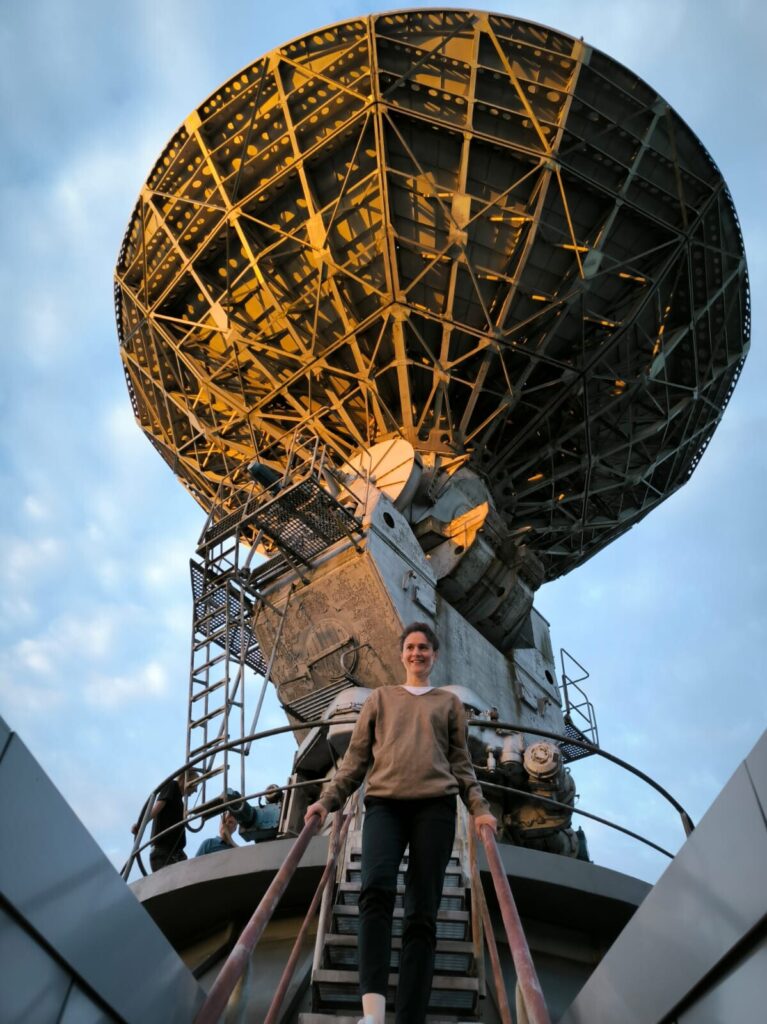
After successfully transitioning into this field in 2018, I have been teaching mathematics and physics at Robert-Havemann-Gymnasium in Berlin. In January 2024, I launched a major radio astronomy project with the goal of making radio astronomical observations and Earth-Moon-Earth radio communications accessible to high school and college students. To this end, I am working with a colleague to convert a former Earth station into a radio observatory.
Girls, as well as working-class children and children from immigrant backgrounds, are more likely to doubt their own talent. The STEM sector must give these talented young people opportunities and reach out to the brilliant scientists of the future right where they are: in school!
I knew I had to take an active role in shaping my future. It helped me when my dreams and projects were taken seriously. Getting to know people from all walks of life who had overcome obstacles or realized their dreams inspired me and showed me that so much is possible.
I wanted to explore the infinitely small and the infinitely large. Along the way, I had to ignore discouraging comments like “too difficult” and “impossible.”
As a child, I didn’t have a clear idea of what career I wanted to pursue. However, I was fascinated by the exploration of nature and spent a lot of time at the science museum watching experimental setups and live experiments.
My fascination with astronomy began in high school. Back then, I constantly flipped through my only astronomy book and read it so often that I could visualize the Hertzsprung-Russell diagram with my eyes closed. At my high school, two dedicated teachers organized astronomical observations for students after school. Observing distant celestial bodies through a telescope was the catalyst for me. My goal has become to measure and investigate the invisible and unexplained phenomena of the universe. I still pursue this goal at school today. Through many projects, I build a bridge between research and school to motivate students to engage with the natural sciences.
My parents had a huge influence on my studies and my career. My mother comes from a poor family and has always approached life with an open mind. She instilled in me a sense of curiosity, a thirst for knowledge, and creativity. My father only attended school through fourth grade; then the Algerian War began. His village was burned down, the men were killed, and he had to work so that his mother and sister wouldn’t starve. He later fought so that my siblings and I could gain the freedom to make our own life choices through school and education.
Later, I was fortunate enough to meet several professors and researchers who gave me strength and self-confidence. During my internship at a Max Planck Institute, the researcher Dirk let me conduct experiments on my own. I was 21 years old. Back in France, I gave a presentation about it at my university. When I described my daily routine in the lab, two professors said to me, “You’re not going to tell us that you created and analyzed thin films all by yourself using a 2-million-euro machine!” and laughed. I ran home in tears. My results were published, and I’ve always enjoyed working with Dirk. In Feb. — 23 years later — I visited the institute with my advanced physics class!
Today, as a mother and teacher, I make sure that girls, working-class kids, and children from minority groups gain the self-confidence they often lack.
I grew up in a big city without a television, and public libraries played a major role in my life. As a student, I wondered how specialized books were created. While working on my dissertation, my advisor Julien taught me the importance of experiments in generating new knowledge. “The measurements we take today,” he often said, “are our questions to nature.” The answers will shape the physics textbooks of the coming decades.
Planning and conducting measurements, as well as critically evaluating the results, are important aspects of physics education.
Today, I am a happy teacher and feel at home at my school. Working with young people gives me new ideas and inspiration every day. With all their diversity, the students are lively, demanding, sluggish, and lazy, but also touching, forward-thinking, and creative. They are our future. With the support of my dedicated colleagues, I strive to attract young talent to the natural sciences, engineering, astronomy, and amateur radio.
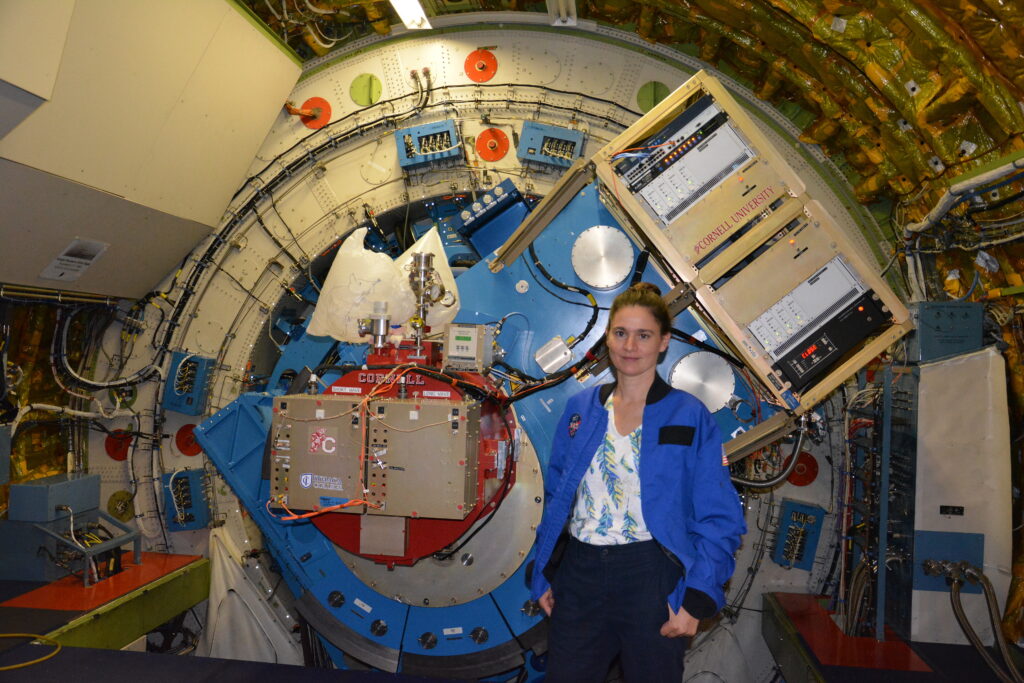
In September 2022, I had the privilege of participating in a NASA/DLR mission and being on board a flying observatory. I’d love to share my experience.
Every year, groups of students prepare measurement campaigns for stratospheric flights: We launch stratospheric balloons equipped with sensors, and the students analyze the measurement results after the flight.
In July 2024, a radio link was successfully established with a German polar research team in Antarctica. The students were able to ask the researchers their questions.
Since January 2024, I have been leading the FUTURA project and giving two inactive satellite antennas, with diameters of 12 m and 11 m, a second life. In close collaboration with amateur radio specialists from Germany and France and with the University of Kiel, we are setting up a radio observatory for educational purposes. At the focal point of the largest antenna, we installed a receiver soldered by a student and used it to receive the first radio signals from our galaxy. The Doppler shift of quantum jumps in hydrogen clouds 10,000 light-years away from us: I find it incredible that we can measure it and that students are learning to analyze the measurement data!
The ability to handle criticism well, tenacity and perseverance, a focus on what matters most, open-mindedness, adaptability, creativity, resilience, stress management strategies, and the determination to always give my best.
Dear young women, look to the future, it is waiting for you. You will have to fight to make your dreams come true. But don’t forget: you are much better than you think! Because you work differently than men, you are the best complement and asset to science. Women empower and motivate teams of men, and together, everyone achieves better results. Be confident and become a scientist, engineer, teacher, or physicist. I wish you every success!
Contact Information
Bitte beachten Sie unsere aktuellen Hinweise.
Tel. 069 / 713 79 69-0
Das Telefon ist von Mo. – Fr. zwischen 10:00 Uhr und 12:00 Uhr besetzt.
Fax 069 / 713 79 69-190
info@experiminta.de
|
Uploaded
Failed
|
![]() |