- News
- Visit
- Column 2
- Opening hours outside of Hessian school holidaysMon-Fri 9.30am - 2pm, Sat,Sun 10.30am - 5.30pmOpening hours during the Hessian school holidaysDaily 10:30am - 5:30pm
- Activities
- Exhibitions
- Group
- EXPERIMINTA
- English
- News
- Visit
- Column 2
- Opening hours outside of Hessian school holidaysMon-Fri 9.30am - 2pm, Sat,Sun 10.30am - 5.30pmOpening hours during the Hessian school holidaysDaily 10:30am - 5:30pm
- Activities
- Exhibitions
- Group
- EXPERIMINTA
- English
- News
- Visit
- Column 2
- Opening hours outside of Hessian school holidaysMon-Fri 9.30am - 2pm, Sat,Sun 10.30am - 5.30pmOpening hours during the Hessian school holidaysDaily 10:30am - 5:30pm
- Activities
- Exhibitions
- Group
- EXPERIMINTA
- English
* 1966 | Germany
Field: Technology
Carpenter | Master Carpenter | Restoration Specialist | Energy Consultant
My Work:
Head of the Department of Historic Preservation at the Raesfeld Castle Academy of Crafts
Brief job description:
Head of the Department of Continuing Education in the fields of historic preservation, traditional crafts, construction and energy technology, and comprehensive training programs such as the “Restorer in Traditional Crafts – Master Professional” and “Energy Consultant for Historic Buildings”
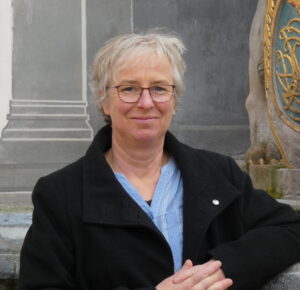
Heike Notz
“We should be more on the construction site!”

Her vision for “Women in STEM”
What helped me were unconventional construction collectives that had a completely normal attitude toward women in the construction industry. With the support of the entire community surrounding the “Reisende Gesell*innen,” my own carpentry collective, and the regular meetings of construction tradespeople, I created my own world of normality within the trades.

Did you have a clear idea of what your future would look like when you were a child?
No, as a child I didn’t have a clear idea of what my future would look like. I’ve enjoyed doing crafts since I was little. At school, it annoyed me that we girls were only allowed to take 50% of our classes as shop class and had to spend the other 50% on needlework. The boys got to do 100% woodworking, which was unfair. Luckily, I was able to try everything out at my friend’s house in her father’s hobby basement and also at home, and just get started without anyone worrying about my little fingers.
Things and experiences from my childhood and youth that I still fondly remember:
- my own toolbox
- building huts in the woods with school groups and friends, and
- an adventure playground with a tool lending station (a big trend in child-rearing in the 1970s) in my hometown of Berlin.
My childhood dreams for the future ranged from flight attendant to lumberjack in Canada. Over time, perhaps my “wandering” through dilapidated buildings (now called “lost places”) and squatting also led to my particular fondness for old things and buildings. Even back then, I unconsciously had the idea of preserving the old and turning it into something useful. I still do that today.
Which person(s) or experience(s) had the greatest influence on your decision about what career to pursue, and why?
Ultimately, the rejection of my application to the HDK (University of the Arts) had a major impact on my life. That’s when I got the idea to become a cabinetmaker. I figured I could always study art later. After completing my apprenticeship, however, that didn’t seem so important anymore, even though I still enjoy painting and sculpting. It wasn’t until I went on my journey as a journeyman that I found female role models in the trades.
Please tell us how your interest in your profession, field of study, or craft was sparked.
At the BBZ (Vocational Training Center), I saw an interesting film about furniture restorers. I found it fascinating, but the path to getting there seemed endless to me. Still, it may have been a subconscious nudge, because today I’ve ended up almost exactly there.
Preserving old structures and working on existing buildings has always come naturally to me, so the path to historic preservation came automatically. It became increasingly clear to me that the truly interesting craftsmanship lies in working with historic building structures. In traditional carpentry, I now see only mindless assembly of prefabricated parts, which is hardly challenging. Today, I lead the continuing education program for craft restorers and rarely work at the saw anymore.
What do you like most about your current job?
Collaborating with others to contribute to historic preservation and education is always important. I have reached my goal. I enjoy working with my colleagues, dedicated instructors, and engaged participants.
These qualities have helpeda me along the way:
I’m quite handy. Ever since I was little, I’ve been proud of my ability to roll up my sleeves and get to work; I’m not afraid of getting dirty or dealing with cobwebs, and I have no fear of heights. I like to get involved, I’m naturally curious, and I’m open to new things. I enjoy organizing to help us achieve more together. Today, I’m the Chair of the Board of the Dachverband der Restauratoren im Handwerk e.V. (Umbrella Association of Restorers in the Crafts). This position and this volunteer role also help me continue to grow. Networking is important!
If you could give young women some advice, what would it be?
Don’t listen to other people’s career advice; listen to your own interests instead. Start the training program you’re interested in and build on it from there. Find the right people to support you; support never hurts. Also keep in mind that technical careers generally pay better.
Contact information

Öffnungszeiten
Bitte beachten Sie unsere aktuellen Hinweise.
Kontakt
Tel. 069 / 713 79 69-0
Das Telefon ist von Mo. – Fr. zwischen 10:00 Uhr und 12:00 Uhr besetzt.
Fax 069 / 713 79 69-190
info@experiminta.de