- News
- Visit
- Column 2
- Opening hours outside of Hessian school holidaysMon-Fri 9.30am - 2pm, Sat,Sun 10.30am - 5.30pmOpening hours during the Hessian school holidaysDaily 10:30am - 5:30pm
- Activities
- Exhibitions
- Group
- EXPERIMINTA
- English
- News
- Visit
- Column 2
- Opening hours outside of Hessian school holidaysMon-Fri 9.30am - 2pm, Sat,Sun 10.30am - 5.30pmOpening hours during the Hessian school holidaysDaily 10:30am - 5:30pm
- Activities
- Exhibitions
- Group
- EXPERIMINTA
- English
- News
- Visit
- Column 2
- Opening hours outside of Hessian school holidaysMon-Fri 9.30am - 2pm, Sat,Sun 10.30am - 5.30pmOpening hours during the Hessian school holidaysDaily 10:30am - 5:30pm
- Activities
- Exhibitions
- Group
- EXPERIMINTA
- English
*1966 | India
Field: Natural Sciences
My work:
Professor of Archaeometallurgy at the National Institute of Advanced Studies, Bengaluru
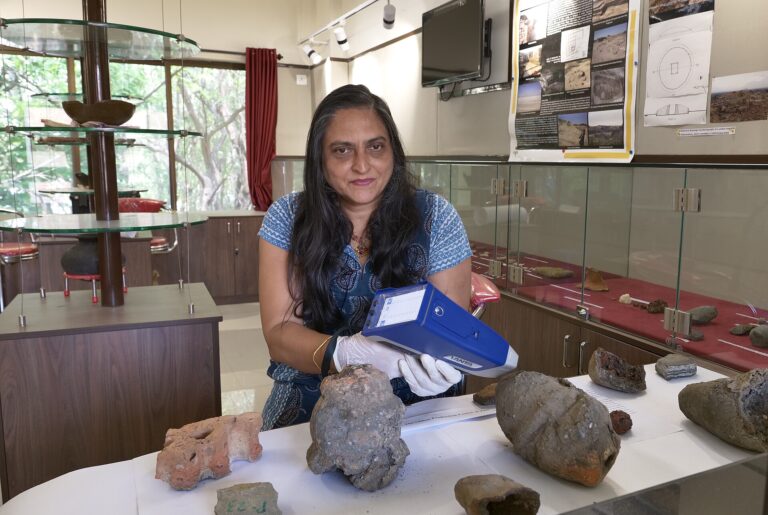
Sharada Srinivasan
"You shouldn’t be afraid to think outside the box, to break new ground and realise your full potential."

Your vision for ‘Women in STEM’
I hope that more women will break through the glass ceiling when it comes to leadership roles in STEM.
Their increased involvement in interdisciplinary topics relevant to science and society, such as research into material heritage, which has the potential to alleviate inequalities, such as those faced by marginalised craftspeople, could contribute to a more sustainable future.

Did you have a clear idea of what your future would look like when you were a child? How did that evolve? Did your vision come true?
As a child, I had wide-ranging interests and a thirst for adventure. I loved stargazing and wanted to become an astronaut, which led me to study for a Bachelor’s degree in engineering physics. But I also loved wandering around ancient monuments and practising the classical South Indian Bharata Natyam dance, which has links to traditions of metal and stone sculpture. My background in physics and engineering proved beneficial in the career choice I eventually made: the study of archaeological materials and archaeometallurgical characterisation through spectrochemical and compositional analysis of artefacts and craft technologies. It was, therefore, a natural progression, drawing on a variety of influences and bringing together my interests in science, culture and society.
Which person(s) or experience(s) had the greatest influence on your decision about which career to pursue, and why?
My interest in archaeometallurgy, specifically the application of mass spectrometry to determine lead isotope ratios in metal sculptures of various origins, was indirectly influenced by my familiarity with uranium-thorium geochemistry; a subject from my childhood with my father (Dr M. R. Srinivasan), who was involved in the construction of Indian nuclear power stations and often explained nuclear fission reactions.
I was also influenced by the late biotechnologist Dr C. V. Seshadri, who, in his work on appropriate technologies for rural areas, highlighted the marginalisation of rural artisans. This motivated me to document skilled but forgotten legacies of craft technologies, such as the production of tin-rich beta-bronze vessels and tin-rich mirrors made from delta bronze.
Please tell us how your interest in your profession, academic field or trade was sparked.
I began to take an interest in the study of metals and material heritage as neglected disciplines within the Indian context. In the 1980s, Joseph Needham and Cyril Stanley Smith emphasised the need for a more intensive engagement with non-Western and Asian cultures. The latter mentioned the metallurgical significance of Damascus steel blades in ‘A Search for Structure’. As it was assumed that these blades were made from Indian wootz steel ingots with a high carbon content, I became interested in deciphering the earlier manufacturing processes through the identification of metallurgical waste and archaeological samples. These are also of interest as advanced materials with probable properties such as superplasticity and the presence of carbon nanotubes.
What do you like most about your current job?
I enjoy the variety of technologies I work with in my research, ranging from high-tech laboratories to rural craft-based settings. I work with cutting-edge technologies such as emission spectroscopy, mass spectrometry and electron probe microanalysis to characterise artefacts such as the very early martensitic beta-bronzes with a high tin content (23% tin), which I have reported on from the South Indian Iron Age site of Adichanallur. On the other hand, I am also involved in documenting basic technologies that have survived through the use of inexpensive and natural materials. These are important, for example, for producing high-quality items such as the mirrors made in Kerala from high-tin delta bronze (32% tin).
These qualities have helped me along the way:
My mother, Geetha, is an adventurous woman who owned a rice field in Tamil Nadu and was active in nature conservation organisations. She instilled in me an unconventional inclination to venture off the beaten track, which stood me in good stead in the field of archaeology, where I also had to travel to remote mines and metal foundries.
If you could give young women some advice, what would it be?
Women have the advantage that, as they are perhaps more frequently confronted with social issues, they are able to think outside the box. This quality can help forge the much-needed, refreshing links between science and society. And they should not be afraid to think outside the box in order to break new ground and realise their full potential.
Find out more about Sharada and contact details

Öffnungszeiten
Bitte beachten Sie unsere aktuellen Hinweise.
Kontakt
Tel. 069 / 713 79 69-0
Das Telefon ist von Mo. – Fr. zwischen 10:00 Uhr und 12:00 Uhr besetzt.
Fax 069 / 713 79 69-190
info@experiminta.de