* | Germany
Field: Natural Sciences
Undergraduate degree: Applied Natural Sciences | Doctorate: Chemistry
My work:
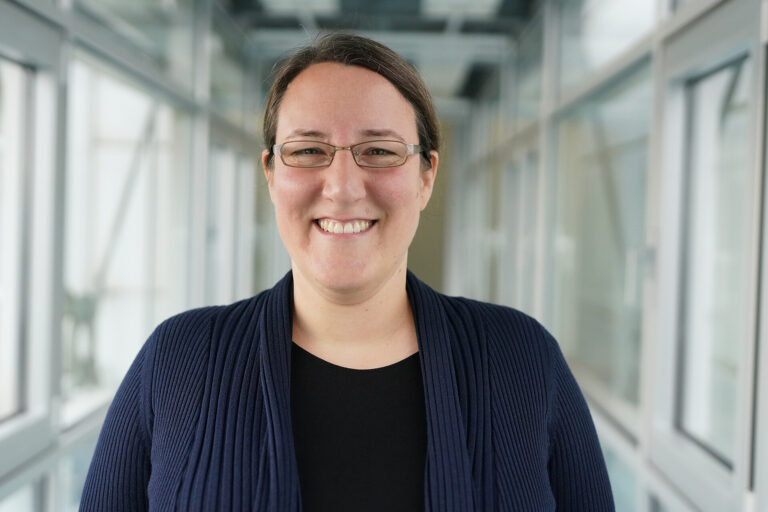
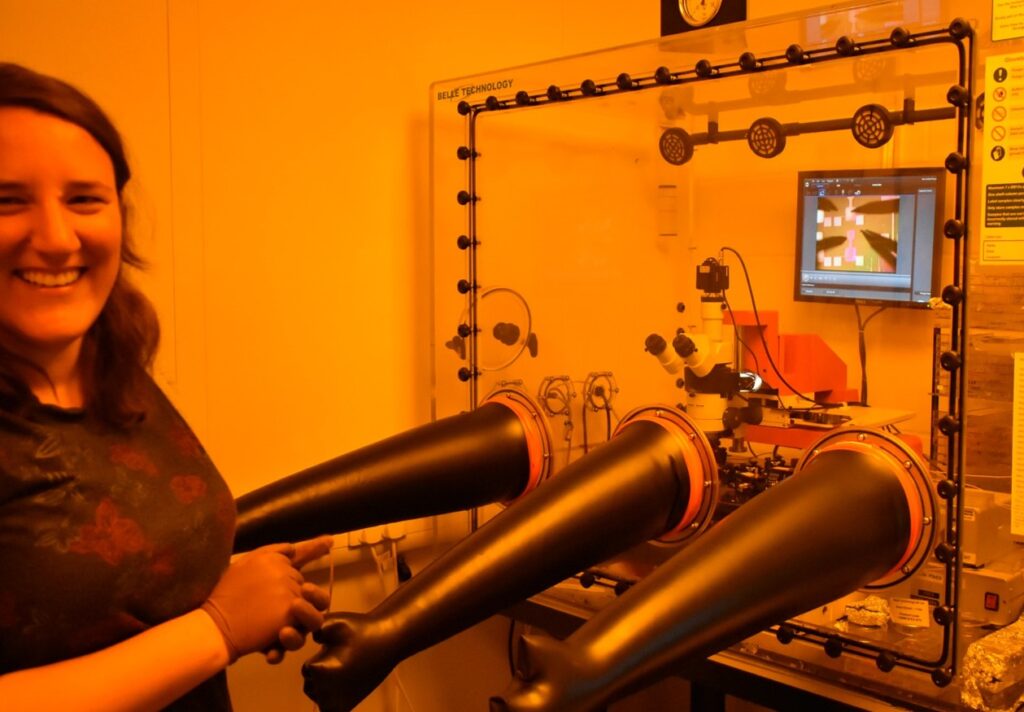
Group Leader at the Max Planck Institute for Polymer Research (Group: Organic Bioelectronics)
Brief description of duties:
My responsibilities include, for example, supervising doctoral candidates and students and discussing their research topics and findings with them, developing research projects and writing grant proposals, authoring scientific publications, handling administrative tasks, writing expert reports, giving lectures and attending conferences, …
I believe female role models are important so that even more girls will consider careers in STEM fields.
I would like to see more women in leadership and management positions and greater visibility for women. I hope that “women in STEM” will eventually no longer be a special topic of discussion and that we will no longer need programs to promote women.
The goal is for everyone to have the same opportunities, regardless of gender, social and ethnic background, or appearance. Science and research benefit from an inclusive environment where every voice is heard and valued, and where everyone can fully develop their abilities.
At my school, teachers used to tell us that girls “aren’t good at math and that science is for boys.” I really hope that this doesn’t happen anymore and that every student is supported in their individual strengths and weaknesses, regardless of gender stereotypes. I think female role models are important so that even more girls will consider careers in STEM fields.
When choosing a university, I deliberately opted for a technical university with 40% female students (rather than one with 5%). Nevertheless, during my studies, there wasn’t a single female professor in the science faculty at that university. As a result, my female classmates also served as my role models. Later, other role models emerged who showed me what women can achieve in science.
I would like to see more women in leadership and management positions and greater visibility for women. That is why I find mentoring and networks for support and the exchange of experiences and advice very helpful. Women have only been allowed to study in Germany for about 100 years. A lot has already changed in a relatively short time, and this progress will continue.
I’ve always been interested in the natural sciences, but I didn’t have a clear idea of what I wanted to do. There are so many possible paths and opportunities. I decided to study “Applied Natural Sciences” because I couldn’t and didn’t want to choose between chemistry and physics. The path into and within the world of science can be winding at times, and I’m still curious to see where it will take me in the future.
My teachers had a big influence on my decision to study the natural sciences: some because they sparked my interest and enjoyment of the subjects, others because I wanted to prove to them that girls and women can do it too 🙂
My parents also played a role. My father is an electrical engineer and taught at a university of applied sciences. As a result, I was running around labs from an early age and had easy access to the natural sciences and engineering.
I didn’t have a single female professor during my studies. The female professors and group leaders I met later on were important role models for me and a sign that women can “make it” in science, too.
Chemistry and physics were always among my favorite subjects in school. On top of that, there was “Girls’ Day” and a school internship in the Department of Chemistry at the Technical University of Braunschweig, where the graduate students shared their enthusiasm for chemistry.
I came across my field of research, organic electronics, while looking for potential topics for a required internship during my studies. The field captivated me because it combined two of my favorite subjects in college (organic chemistry and semiconductor physics).
The interdisciplinary nature of my work continues to inspire me to this day, and within my team, we complement one another with our diverse professional backgrounds (chemistry, physics, electrical engineering, and engineering). Furthermore, my professional environment is very international, and I greatly enjoy intercultural interactions.
I am able to turn ideas into reality. It is exciting to see how my own ideas take shape and evolve from a research proposal on paper into research results and publications. Above all, however, I take great pleasure in working with young, talented scientists and in being able to accompany them for a part of their journey.
A thirst for learning new things and a love of trying new things. Perseverance, a bit of stubbornness, and a sense of adventure.
Don’t let the fact that no woman has done “something like this” yet discourage you. You can be the first and inspire others!
Don’t be afraid of making the wrong decisions. You can always change course. Sometimes, the opportunity to combine two seemingly conflicting passions arises later on.
More about Ulrike and Contact
Bitte beachten Sie unsere aktuellen Hinweise.
Tel. 069 / 713 79 69-0
Das Telefon ist von Mo. – Fr. zwischen 10:00 Uhr und 12:00 Uhr besetzt.
Fax 069 / 713 79 69-190
info@experiminta.de
|
Uploaded
Failed
|
![]() |