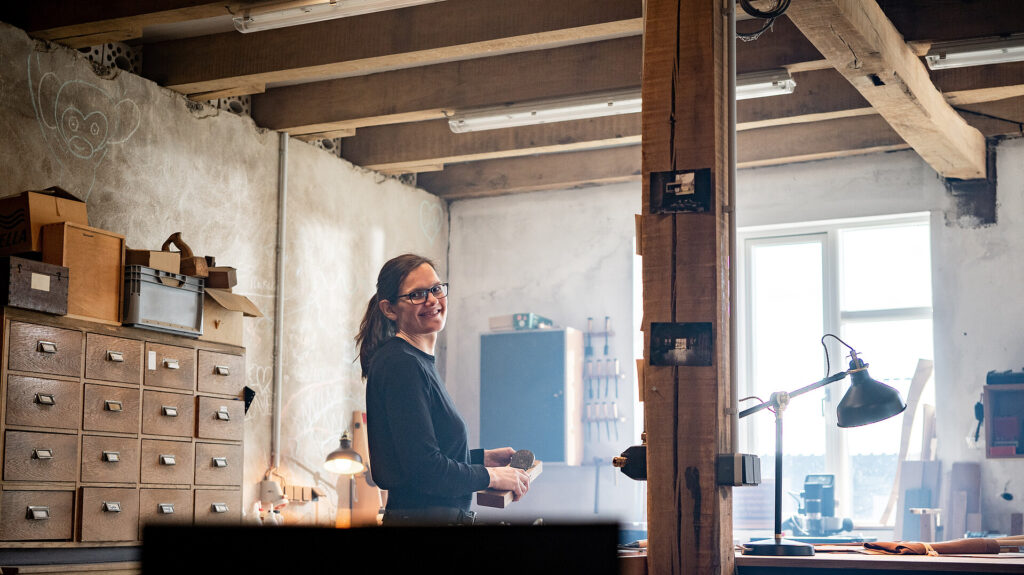
*1988 | Germany
Field: Technology
Master joiner, joinery restorer
My work:
Self-employed as a master joiner and restorer in the joinery trade
Prejudices are like background noise that whispers to you who you are or should be, what you can or cannot actually do, and what interests you or doesn’t. The result of these outside voices is that you can no longer hear your own voice, and you lose touch with who you really are.
It was often difficult to find my bearings without someone who had walked a similar path
— you’ve got me!
Don’t hide or pretend to be someone else; just be yourself
—you’ll be the best artisan!
When I think about my vision for women in STEM, I immediately come to the conclusion that we need to break down prejudices in every way. Here’s a brief glimpse into my experiences during my four-year journey as a journeyman carpenter. I worked for a year in various carpentry shops in Canada, followed by a few months in New Zealand. After that, I spent a year with a sensei in Japan. I found that the prejudices women (and men) face varied from place to place. Do women have enough technical understanding? Can they lift heavy things? Can they handle the pressure? When I have to prove myself first in a particular job, I lose an incredible amount of energy and joy in that very activity. I’ve always felt most at ease when there were simply no such expectations and I could do my work in peace. I believe that prejudices based on stereotypical gender roles have a major impact on self-image and self-esteem, especially among young people.
Prejudices are like background noise that whispers to you who you are or should be, what you can or cannot actually do, what interests you or does not interest you. The result of these external voices is that you can no longer hear your own voice, that you have a harder time experiencing yourself. I believe that, for this reason, we as a society must consciously address this issue to enable everyone to more freely realize their potential.
The result is happier people and a healthier, more motivated working environment.
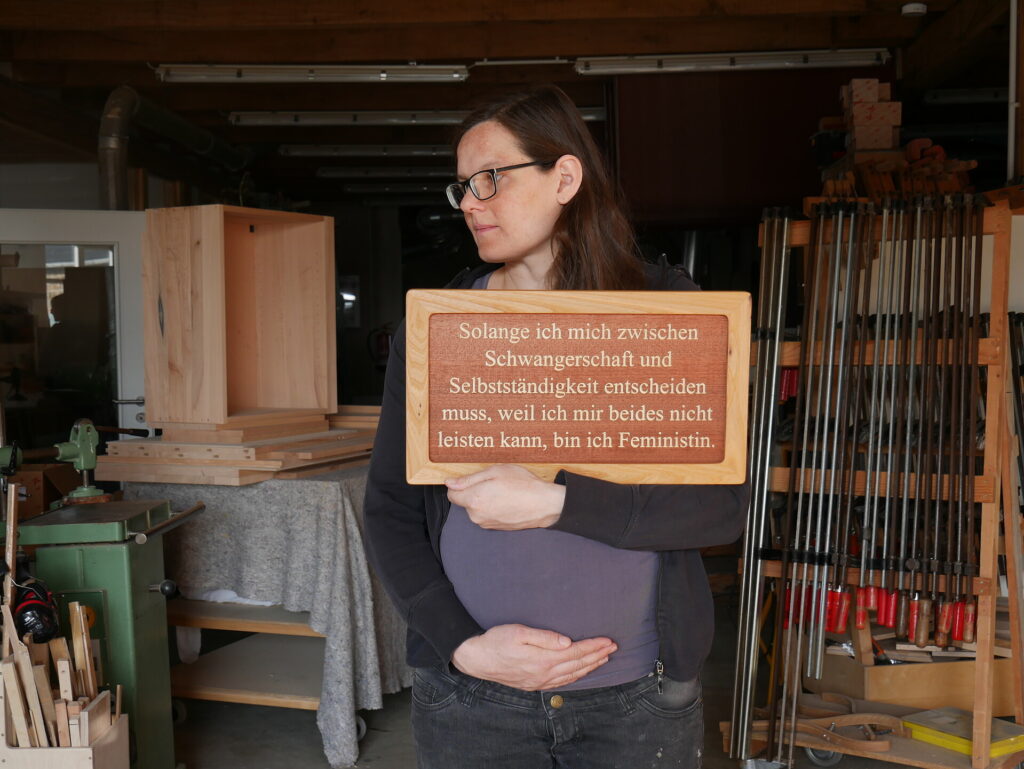
We still have a lot of work to do on the structures so that the labour market is ready for female carpenters! We lament the shortage of skilled workers and promote a diverse trades sector. At the same time, we (tacitly) assume that self-employment means no children are planned. Or at least not for half the population. We leave expectant mothers, those who do dare to try to do both, to face the risks and worries alone. We are proud of our many family businesses, yet we are blind to the fact that, partly due to the existing structures, these are more often passed down from father to son rather than from mother to daughter.
I’ve always found wood a fascinating material. Even as a child, whilst playing, I’d often imagine how I could build something cool out of wood. So I decided to do an apprenticeship alongside my A-levels. I took to the day-to-day work in the joinery straight away. It wasn’t a conscious decision on my part, but one that arose from my interest in the material and the opportunity to do an apprenticeship alongside school. Doing the apprenticeship whilst at school was ideal for me because I didn’t have to choose between my A-levels and practical training. It allowed me to pursue both paths at the same time and thus make a smooth transition into the world of work.
I would have liked to have had role models who had followed this career path. That’s something I missed at times. Role models and encouragement would have been very helpful in giving me more support. It was often difficult to find my bearings without someone who had followed a similar path. The chance to speak to such people would certainly have helped to solidify my decision and given me more courage to pursue this path.
My choice of career wasn’t a conscious decision. At first, I wanted to become a farmer. I took my A-levels at a school where you can do a vocational training course at the same time. I decided to become a joiner. The longer I did the work, the more I enjoyed it, so I stuck with it. My experience is that you become what you do if you genuinely enjoy the work.
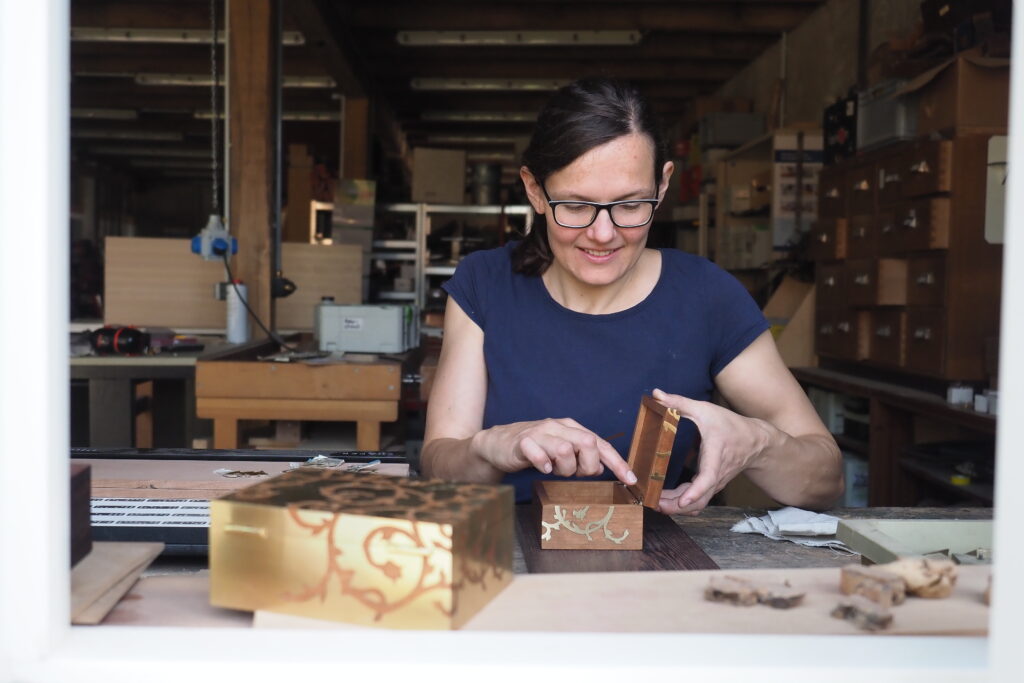
The way I work now is ideal for me personally, yes. Precisely because my daily routine is so varied. For me, being self-employed means I can decide for myself which jobs I want to take on and which clients I work well with. I’m also very flexible with my daily routine. If I feel like drawing and designing, I can do that. If I want to burn off some energy, I’ll do some rough cutting on the circular saw. Depending on how I feel on the day, anything is possible, because carpentry is such a flexible trade. And even if something comes up with my child, as a self-employed person I can react spontaneously, because I’m in charge of my own schedule.
You learn the individual tasks. So you don’t need to have the skills beforehand. You should enjoy being active, understanding and solving problems, and have a certain amount of stamina and patience, as results aren’t immediately visible and sometimes many steps build on one another. You should enjoy working with great precision. Spatial awareness is also an advantage, but you’ll learn the rest during your training. As for the physical demands: there are plenty of techniques that make life easier. So you don’t need to be incredibly strong. The first few months are often tough, but you’ll get the hang of it.
Yes, the barriers are real, and it is often subtle how women are taken less seriously or excluded from planning processes. There are prejudices and an objectified portrayal of women in the trades. For example, some workshops still have pin-up calendars on the walls. We need to treat one another with greater respect.
Despite these challenges, however, I can see that the trades are at a turning point, where more mindful behaviour and a more inclusive culture are taking hold. Most people are also realising that these old ways of behaving and the old adage ‘apprenticeship years are not years of mastery’ have had their day. I actually believe that we are currently managing to attract highly motivated people to the trades, enabling them to stay and find a home there. It’s important not to let yourself be unsettled and to listen to yourself.
You will always find your niche and your path. “That’s how we’ve always done it” has had its day. And all qualities are in demand: you don’t need to give up your sensitivity, your creativity or your desire for good camaraderie just because the trades are rough and rustic. You will become the best tradesperson if you simply be yourself and don’t hide or pretend to be someone else.
Further information and contact details
Bitte beachten Sie unsere aktuellen Hinweise.
Tel. 069 / 713 79 69-0
Das Telefon ist von Mo. – Fr. zwischen 10:00 Uhr und 12:00 Uhr besetzt.
Fax 069 / 713 79 69-190
info@experiminta.de
|
Uploaded
Failed
|
![]() |